
Trace Former Tompkins County Owners Backward
Walk the recorded transfers in reverse. Start with the newest deed you can confirm. Its grantor is an earlier owner or transferor, so search that person as a grantee in an older deed, match the same land description, and keep going. Log every step in a table, because similar names and neighboring parcels slip into chains that nobody checks.
| Transfer date | Grantor to grantee | Deed type | Instrument or book/page |
|---|---|---|---|
| Newest confirmed | Copy exact roles | Read document heading | Save recording citation |
| Prior acquisition | Search current grantor as grantee | Check full or partial transfer | Follow prior reference |
| Earlier link | Repeat with name variants | Note estate or court event | Confirm legal description |
Walk the Grantor-Grantee Index Step by Step
Open Public Records Advanced. Put the current deed's grantor in the grantee field and set an earlier date range. Narrow further with parcel, city, document type, or book and page. Once a likely deed appears, compare the details. Check the municipality, acreage, lot or block, metes and bounds, exceptions, and any prior deed references. A changed legal description means the parcel was split or merged. You need to resolve that before continuing the chain.
- Verify the newest deed and its whole legal description.
- Move the grantor name into an earlier grantee search.
- Confirm the acquisition concerns the same land.
- Record the citation and repeat with the next grantor.
- Document gaps rather than guessing across them.
How Far Back Tompkins County Ownership Goes
County material traces land records back to 1817. The online system leaves its earliest indexed year unstated. So the collection's start date is not the same as what you can reach online. Clerk staff will search for $5 per name back to 1968. Before that year, the fee covers each two-year period and each name searched.
Plan older searches narrowly. Use known owners and approximate transfer years to limit paid two-year blocks and deed-book work.
Reverse indexes, deed books, and microfilm hold the earlier links. The Clerk's 1825 balloting book can add early land context, while a 1911 State Archives fire complicates some state-land research.
Definitions for Previous Owner Research
A grantor conveys the stated interest. A grantee receives it. The chain of title is the sequence of conveyances tied to one parcel, and a reverse index organizes entries by grantor instead of grantee. A warranty deed and a quitclaim deed differ sharply in their language and assurances, so read the document before trusting its label.
A prior owner is not always the prior occupant. Directories, census material, and mailing fields can round out an address history, but they never replace the deed chain.
Estate Transfers in a Tompkins County Chain
Surrogate's Court records date from 1818, with the 1818 to 1910 index book on microfilm. When an executor, administrator, or trustee signs a deed, the estate file holds the fiduciary authority. Record that authority. Then return to the County Clerk for the deed that moved the land. A death date or probate file explains a name change. It does not itself transfer every parcel.
Compare the estate's property references, the court's authority, the deed's legal description, and the grantee. Some interests pass or get resolved through other instruments entirely. Resist forcing an estate event into a simple sale timeline.
Foreclosure and Court Events in Former Ownership
A chain can pass through a delinquency notice, lis pendens, judgment, referee deed, auction, redemption, or another vesting instrument. A pre-auction parcel list proves no sale happened. Search the Supreme or County Court file. Then find the later deed or recorded judgment that touches title.
eCourts can supply a case-number lead. Restricted, sealed, or not-yet-entered matters may simply be absent. Keep the index number and ask the clerk for the actual file. Cite court evidence and recorded land evidence separately.
Directories and Historic Address Changes
Tompkins County Public Library lists city directories from 1864 through 1985, with gaps. It also holds selected obituary and newspaper indexes. The History Center holds family files, maps, ledgers, newspapers from 1819, and HistoryForge. Together these sources tie old street names, occupations, buildings, and residents to a period.
Use them to test a deed chain, not to build one. Street renumbering can dress the same land in different address labels. So can subdivision creation and annexation. So can the City-versus-Town of Ithaca split. The legal description holds steadier than the street line. So does the prior deed reference.
Audit a Tompkins County Former-Owner Timeline
Record every link fully. For each transfer, capture the date, grantor, grantee, document type, instrument number, parcel, legal description, consideration clue, prior reference, and whether the image was reviewed. Flag partial parcels, name changes, estates, and court transfers. A gap is a finding, not an invitation to insert a likely owner.
Historical context is not title proof. Verify each former owner through the recorded chain and seek professional review when a gap affects a legal interest.
Use Advanced Search for Prior Owners
The recorder's advanced search page exposes the fields a backward chain depends on. A parcel or city filter separates shared names. Document type and date ranges cut the unrelated filings. Book, page, and document-number controls exist for a reason. They bring you back to a citation found inside an older deed. See the Tompkins County advanced recorder search for the live interface.
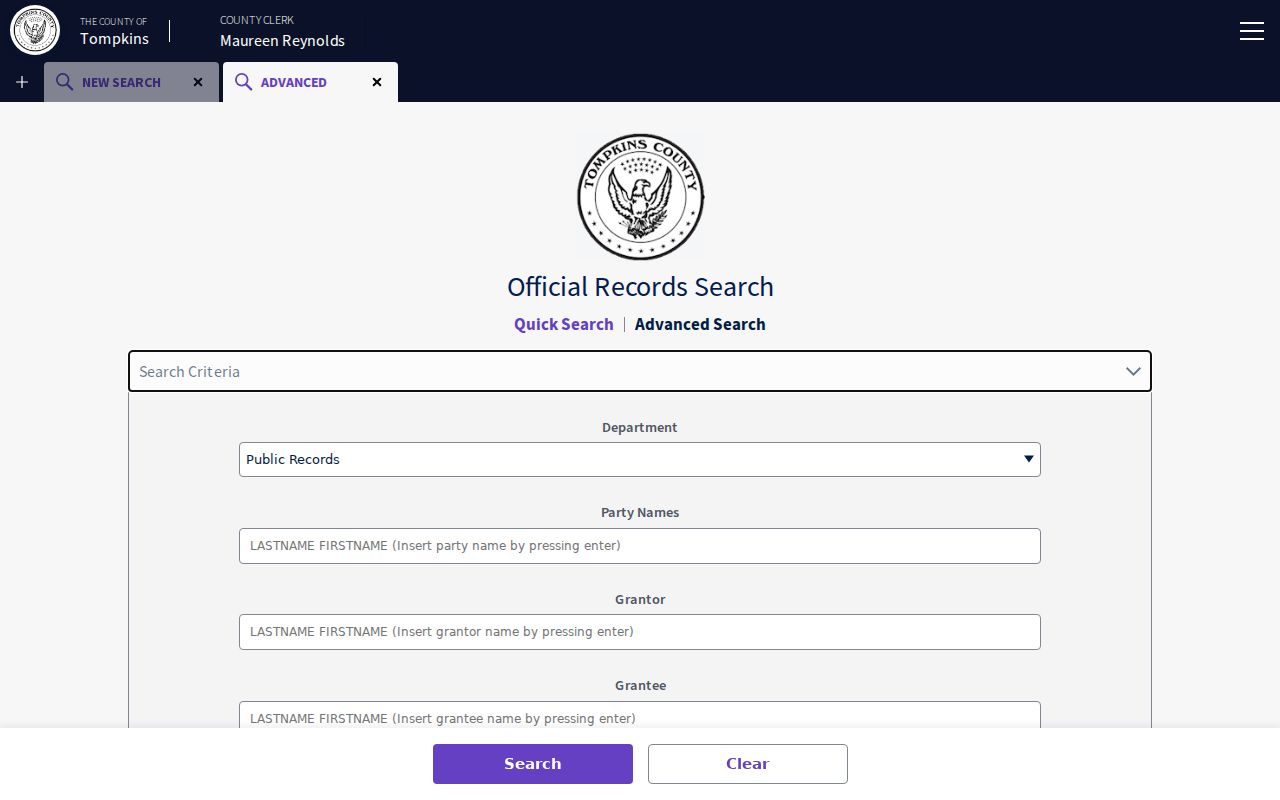
The fields speed discovery, but every proposed link still stands or falls on the document image and a matching legal description.
Name Variants in a Former-Owner Chain
Try name variants only when other evidence backs them up. Initials, full names, spouse pairs, estate styles, trustees, and business punctuation all belong in a careful Tompkins County property search. Just keep the grantor and grantee roles straight, because mixing them can scramble the chain. A directory spelling or an obituary might hint at another query, but neither one can close a deed gap on its own. The same name often shows up across several parcels in the county. When it does, lean on municipality, parcel number, subdivision, and legal description to rule out false matches. Write down any search that came up empty, so future deed records work does not repeat it without a fresh lead.