
Deed Types in Tompkins County Records
The County Clerk's Land Services unit holds Tompkins County deed records and the instruments that surround them. A deed records a conveyance. Mortgages, satisfactions, assignments, judgments, liens, and plats answer related questions instead. Start any deed search with the document type and the party roles, then open the image and read the legal description, consideration clues, reservations, and prior references. Treat the index entry as a finding aid. The instrument itself is what carries the facts.
| Instrument | What to inspect | What it does not prove alone |
|---|---|---|
| Deed | Grantor, grantee, legal description, recording data | Clear title |
| Mortgage | Borrower, lender, amount, parcel reference | Current unpaid balance |
| Satisfaction | Mortgage reference and discharge data | Absence of other liens |
| Judgment or lien | Debtor, creditor, dates, scope | Final enforceability |
| Plat | Lots, blocks, roads, easements | Surveyed present boundary |
Search Tompkins County Deed Records Online
The Clerk's Public Records Quick Search offers date-range searching along with index and OCR modes. Advanced Search opens grantor, grantee, parcel, city, date, document type, document number, and book/page fields. Search both party roles when tracing a transfer. Try full and shortened entity names. Keep the parcel number's punctuation intact. Narrow by municipality or document type when a name floods you with hits. The official Quick Search page displays the recorder interface and its search modes.
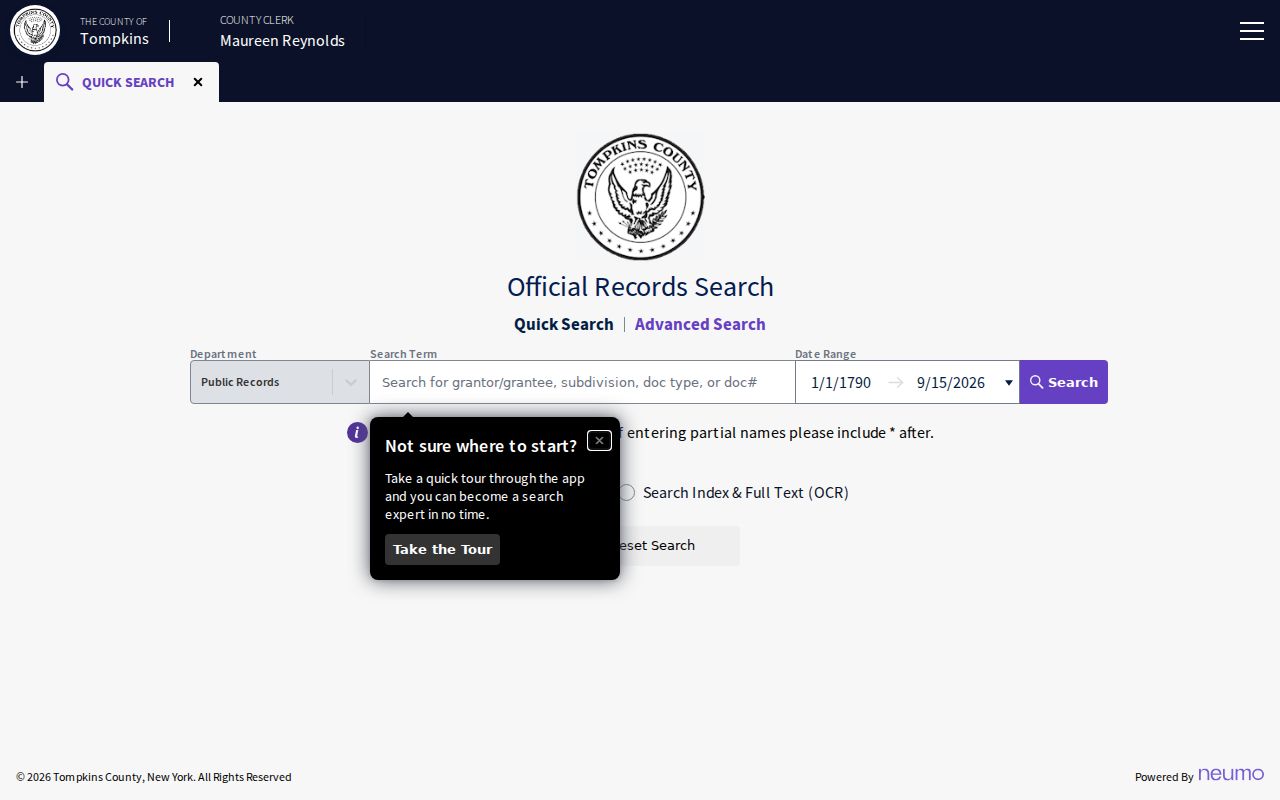
The Clerk's record supplies the recorded image and certification.
Read a Tompkins County Deed from Header to Description
Open with the recording date and the instrument or book/page reference. Next, identify each grantor and grantee without flipping their roles. Note the deed type and the consideration or transfer-tax clue. Jot down the municipality, the parcel identifier, and every citation to a prior deed. Only then read the legal description in full. It may lay out a subdivision lot or metes and bounds. It may carve out an exception, an easement, or land the grantor kept.
Names alone make poor matching keys. Trusts, estates, business entities, initials, and spelling variants can open apparent gaps in the chain. The parcel number and legal description are what tie the document to actual land. When a deed covers only part of a former parcel, compare the plat or GIS map for context. Get a survey before drawing any boundary conclusion.
Coverage of Tompkins County Deed Records
The county describes its land records as running from 1817 to the present, though the online index does not state an earliest digitized year, so complete 1817 coverage online is not guaranteed. Clerk staff will run a search at $5 per name back to 1968. Before 1968, that fee applies to each name and each two-year period searched. Costs climb quickly. A focused name and date plan matters for older deed records.
Online cutoff unresolved. County collection coverage begins in 1817, but the live portal's earliest searchable online year was not displayed.
Deeper historic work may call for reverse indexes, deed books, microfilm, or an office request. The 1825 balloting book and local archives add context, but a transfer belongs in the deed chain itself.
Order Tompkins County Deed Copies
Land Services sits at 320 N Tioga Street in Ithaca and answers at 607-274-5431. Requests are accepted in person, by telephone, or by email, and the county asks for specifics: names, municipality, address or parcel, document type, known dates, and a recording citation. Copies run 65 cents per page with a $1.30 minimum, and certification adds $5. A plain image often serves preliminary research. A certified copy fits when an agency, court, attorney, or transaction needs the Clerk's authentication. Ask the recipient which form is required before paying. Confirm the current fee schedule with the office, since charges and delivery methods change.
Recording and eRecording in Tompkins County
Tompkins County began accepting electronic recordings on September 24, 2012, though eRecording remains optional. CSC, Simplifile, and ePN serve as vendor channels. Their charges sit apart from county fees. The local schedule lists a $50 first-page recording charge. It adds $5 per added page for specified deed, mortgage, assignment, and discharge categories. Required tax forms and notations carry separate charges. These filing fees say nothing about the cost of downloading or ordering an existing deed. Before submitting any instrument, use the county's current checklist. Also consult a professional about execution, acknowledgment, tax forms, and the legal description. The Clerk records documents but will not draft a deed. The Clerk also will not certify that a transfer cures a title defect.
Build a Tompkins County Chain of Title
Start from the newest verified deed, not just the assessment's owner of record. Copy the grantee and grantor. Copy the recording date, document number, deed type, parcel, legal description, and prior-instrument reference. Then hunt the current grantor as a grantee in an earlier period. Repeat that step, testing every transition against the same land description. Estates, foreclosures, mergers, subdivisions, and name changes can all break a tidy person-to-person chain.
Surrogate's Court records can explain a fiduciary's authority in an estate. The County Clerk records the land instrument itself. A court docket may point to a partition, quiet-title, or foreclosure file. It does not replace the final deed or judgment. Keep each source in its proper role.
Deed Alerts and Fraud Caution in Tompkins County
Tompkins County deed records gained a new alert option. It arrived with the January 2026 Public Records platform launch. The service lets users monitor keywords or documents. Its disclaimer governs what it promises. An alert can flag a newly indexed filing, nothing more. It cannot guarantee title, block a recording, or verify identity. If an unfamiliar record appears, review the image and contact the Clerk promptly.
Resist the urge to fix a suspected title problem with a homemade instrument. That almost always makes things worse. Instead, preserve the alert, the instrument number, the image, and the date. Seek legal advice when the issue touches authority, forgery, priority, or ownership. New York's homeowner-scam guidance is a solid safety resource. Still, the county record controls what was actually recorded.
Limits of Tompkins County Deed Records
Deed records in Tompkins County show one thing: instruments accepted for recording. They do not identify every occupant. They settle no boundary dispute. They cannot promise that no unindexed interest lurks in the chain. OCR can misread names, indexing can rely on an entity or estate name, and a quitclaim deed describes only the interest conveyed without promising the grantor held good title, so the effect of any deed still depends on its terms and the law.
Recorded does not mean verified title. Use an attorney or title professional for a legal conclusion and a licensed surveyor for disputed boundaries.
Tompkins County Deed Research Checklist
Close out a Tompkins County deed search with discipline. Compare the municipality, Printkey, legal description, and prior instrument across every candidate deed. Note whether you reviewed the image or only the index. Search satisfactions whenever a mortgage matters. Search judgments and liens separately, because a deed-only result is incomplete for encumbrance research.
For a certified copy, give Land Services the exact document number or book and page. For an older gap, supply both party names plus the narrowest defensible date span. This record discipline keeps the work reproducible. It stops an OCR hit from being mistaken for the subject parcel. It stops a common surname too.