
What a Tompkins County Property Value Means
Ask what question you want answered first. Assessment exists for tax administration. Full market value is a roll estimate inside that framework. Taxable value shifts after exemptions and other adjustments. A sale or consideration amount is different still: it comes from transaction reporting and the recorded deed. None of these numbers is automatically a private appraisal or a current offer price.
| Value type | Meaning | Where recorded |
|---|---|---|
| Land assessment | Roll value assigned to land | Assessment roll |
| Total assessment | Roll land and improvement value | Assessment roll |
| Taxable value | Value after applicable roll treatment | Assessment or tax roll |
| Full market value | Market-value field in assessment context | Assessment roll |
| Last sale or consideration | Reported transaction amount | RP-5217 report and deed clues |
Look Up Assessed Value in Beacon
Start with the situs address in Beacon. Verify the municipality, then copy the Printkey. Record the assessment, land, total, taxable value, full market value, exemption code or amount, roll year, and property class exactly as displayed. If the vendor system is down, the county links official final-roll PDFs as a fallback.
- Find the correct parcel by address or Printkey.
- Confirm City, Town, or Village context.
- Copy each labeled value without merging fields.
- Record the roll year and final date.
- Compare another year only after confirming the parcel did not split or merge.
Tompkins County's 100 Percent Assessment Context
Tompkins County assesses at 100 percent of market value countywide. The 2025 New York State Market Value Survey and county annual-report material say as much. That context helps you read the relationship between assessed and market-value fields. It does not promise a parcel would sell for the printed figure. It cannot replace an appraisal. Plenty of things move the roll from year to year. Physical changes, classification, exemptions, corrections, and the annual valuation process all play a part. Compare like fields from the same effective year. A percentage alone cannot explain a change. You need the parcel's record and assessment history behind it.
Where Tompkins County Sale Prices Appear
Sale prices live in a different corner of Assessment than values do. The office publishes daily RP-5217 sales reports covering 2023, 2024, 2025, and daily 2026 material. It labels the daily data unreviewed. Residential comparable searches reach back to instructions beginning January 1, 2023. For nonresidential, vacant-land, and mobile-home searches, ImageMate is the stated route. The deed itself may hold a consideration or transfer-tax clue. Any reported price needs context, though. Check the deed description, property class, transfer type, related parties, multiple parcels, and recording date. A nominal or combined consideration amount may not describe an ordinary market sale. It may not match the exact parcel.
Exemptions Change Taxable Value
An exemption can reduce or reshape taxable value without touching the parcel's physical characteristics or its recorded sale. The county posts exemption and grievance forms through Assessment. Eligibility, proof, and deadlines all depend on the program. The calendar is fixed: taxable status falls on March 1, the tentative roll on May 1, and the final roll on July 1. Always keep the exemption code and amount with its roll year. One year's taxable value and another year's total assessment are not the same measure, so never compare them directly. Eligibility and correction questions belong with Assessment. A payment question belongs with the collector.
Assessment Is Different from the Tax Bill
Property value is one input to taxation, never the amount due. Rates, districts, exemptions, levies, credits, penalties, and payments all shape the bill or account. Tompkins County Assessment states plainly that it maintains no paid or owed tax information. For current balances, go to the collector. That may be the city, town, village, or school. County Finance also handles current balances. The City of Ithaca tax-roll warning shows why this matters. Later delinquent charges or credits can appear. They can make a produced roll incomplete for a present balance. Keep value analysis and payoff research separate.
Compare Tompkins County Property Values Across Years
Build a year-by-year table with the essentials. List the Printkey, municipality, property class, land, total, taxable, full market value, exemptions, and roll date. Note any parcel split, merger, building change, or classification change as you go. Then add sale events in a separate column. That discipline keeps a transaction from masquerading as an assessment, and vice versa. A historic directory or permit can explain when a structure or address changed. Neither supplies market value. An Ithaca permit application also does not prove approved work was finished. Use issued files, assessment changes, and physical evidence with care.
What Tompkins County Property Value Does Not Tell You
Know the limits before leaning on any figure. The roll cannot predict a negotiated sale or guarantee condition. It cannot expose hidden defects, either. Nor can it replace a lender or private appraisal. GIS cannot settle acreage or boundary disputes. A daily sales line cannot prove two properties are truly comparable. Every source here is a dated government record with a defined administrative purpose.
Value is not an appraisal. Use assessed value for roll research and qualified professionals for a current market or lending opinion.
Review the Tompkins County Sales Source
The county's daily sales page is the official route to current RP-5217 report links. It warns that the daily data is unreviewed. Use it to spot a possible transfer. Then inspect the deed and parcel details before comparing values. A date or amount alone cannot show whether the transfer covered multiple parcels. It also cannot reveal whether the deal involved related parties or reflected typical market exposure. See the Tompkins County Daily Sales Reports page for the report links it displays.
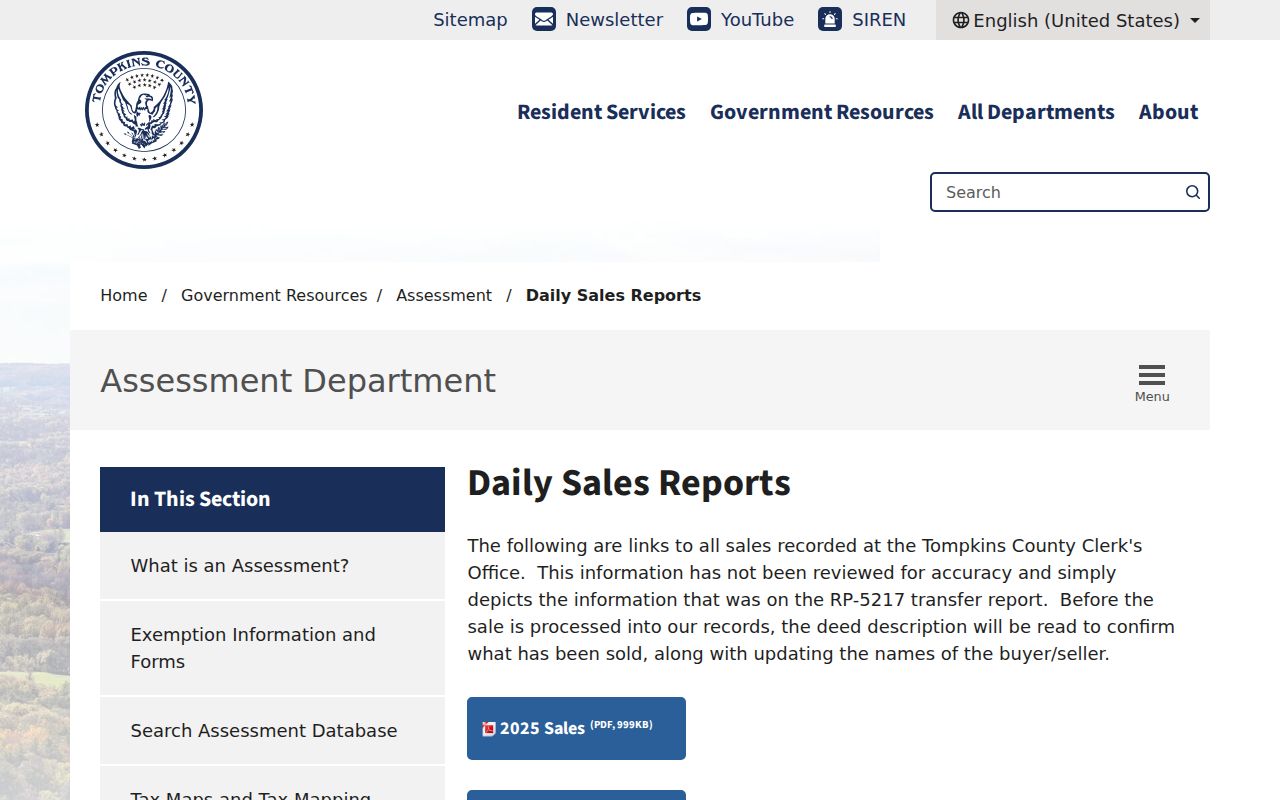
That warning is exactly why sale evidence belongs in its own column beside, never in place of, assessed and full market value.
Property Value Research Worksheet
Start with one line per year. Note the municipality, the Printkey, the property class, and the LAND and TOTAL figures. Then add TAXABLE VALUE, FULL MARKET VALUE, and any exemption. Include the ratio or level and the roll date.
Give each transaction its own line. Record the sale-report date, the deed recording date, and any price or consideration clue. Note the deed type and whether the description was checked. Parcel splits, mergers, permits, and classification changes deserve a note. That note should stand only when an official source backs them. This layout keeps trends clear without mixing unlike numbers.